Most agencies tell you what they could build. A digital product studio shows you what it has built. We are a marketing and AI automation consultancy in Malta, and we also design, build and run our own products: Handled, Malta Calculator, Bla Dawl and Space Right Now. None of them is a client project. We built them to solve real problems, to test our own delivery system, and to give you something real to judge us by. This is what we made, what happened, and what it means if you want something built.
What a digital product studio does
A digital product studio takes an idea from a question to live software, then keeps running it. That last part is what separates it from a design shop or a development contractor. Strategy, brand, design, engineering, AI, search and analytics all sit in one team, and the team lives with what it ships.
We came at this from marketing. After 15 years across fintech, iGaming, hospitality and B2B SaaS, our team knew how products get found and sold. AI changed how fast a senior team can build. Put those together and an agency can do more than advise on a product. It can make one.
Why an agency should build its own products
There are three reasons, and the first is the most important.
You find out what is true. Advice is cheap until you have to live with it. Running your own product means your own analytics, your own broken deploys and your own honest numbers.
It keeps the delivery system sharp. Every product here taught us something we now use in client work.
It gives you proof you can check. A case study is a story. A live product is a thing you can open right now.
The four products
Bla Dawl: a live power cut map, built in one evening
During the heatwave power cuts of July 2026, repeated grid failures left Maltese towns without electricity in extreme heat. We set ourselves a brief that evening and shipped a free, mobile-first map with electricians and cool-down spots alongside it.
Version one went from brief to live on 23 July. Within 42 hours, 2,400 people were using it, and the crisis dataset reached 708 reports across 55 of Malta's 68 localities. Analytics went live about four hours after launch, so early traffic is undercounted, and reports are per device rather than per household. Read the full Bla Dawl story or the case study.
It proves that a real product can reach the public in hours when research, build and review run side by side, and that the work continues long after launch night: street mapping, guides and a widget for other sites followed over the next five days.
Handled: AI review replies with a person in charge
Handled keeps a business's Google reviews in one feed and drafts each reply in English, Maltese or Italian. The owner approves every reply. It has no customers yet and a small pilot is its next step, so its proof is engineering: 237 automated tests at the September release and row-level security on every public table. We wrote up how we built it.
It proves we can build a product with an AI layer, a human approval step and proper security, and draft in a small language such as Maltese, with the owner checking every draft. The next step is proving it with real businesses, and we are saying so here rather than hoping you will not ask.
Malta Calculator: figures that show their workings
Malta Calculator offers 15 free tools for everyday costs in Malta and Gozo. Its public check page lists 27 sources, with 26 shown as matched on 5 November and one links only, and a check is set to run every Monday. It launched in November 2026, so we make no traffic claims yet. Here is how we keep the figures right.
It proves what careful content, design and automation look like together. One checked file feeds every tool, a person reviews any change to an official figure, and the artwork gives a utility site some character. It is also the clearest example of building for search from the first day.
Space Right Now: a passion project with 1,000-plus pages
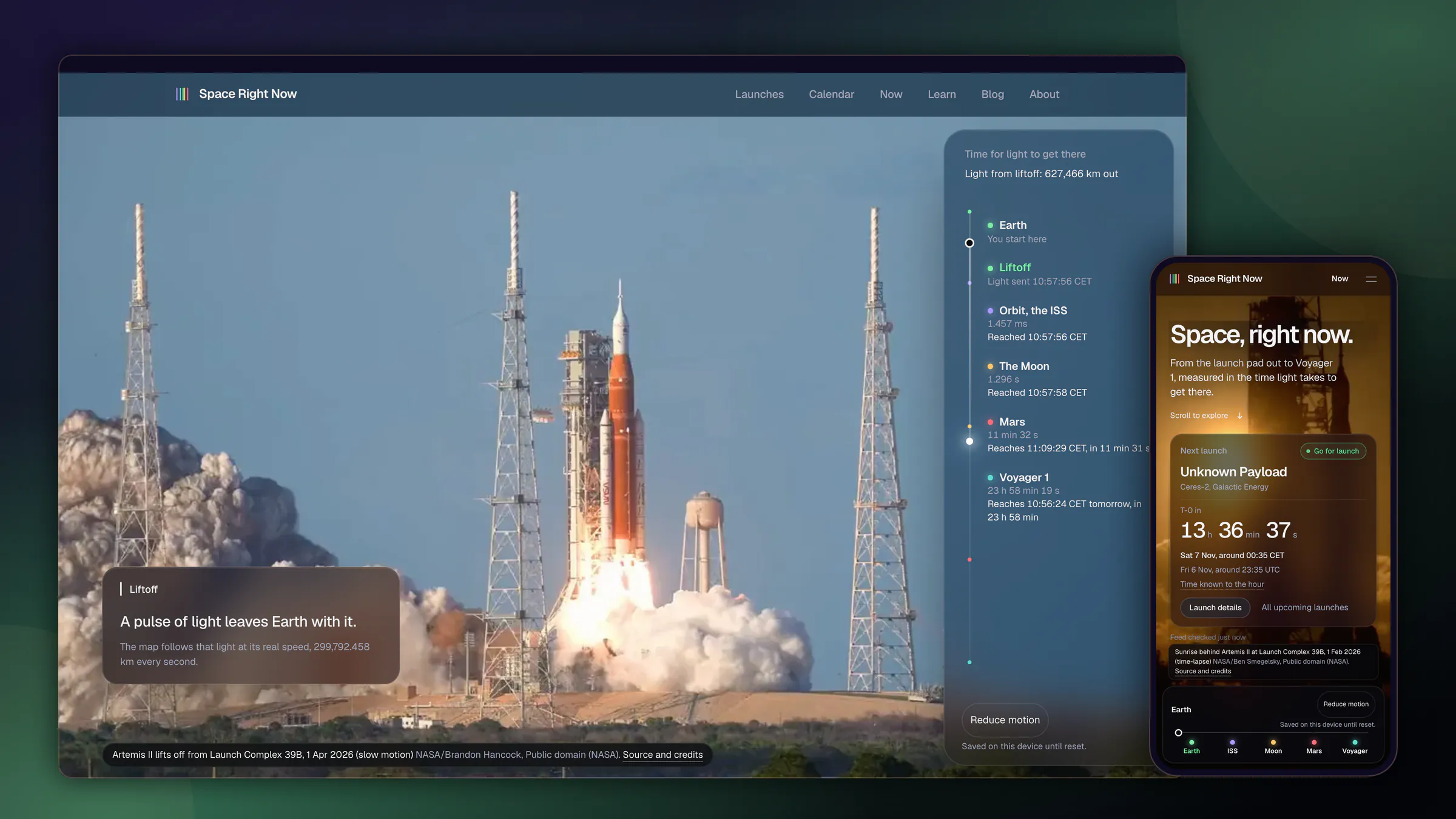
Space Right Now is a non-commercial project that follows launches, the ISS and Voyager 1 on a 3D journey outward from Earth. Every launch time says how precisely it is known, across more than 1,000 pages generated from a scheduled feed. Read how we built the tracker.
It proves we can turn messy, moving data into something people can trust, at a scale of more than 1,000 pages, and make it beautiful. It scored 100 for mobile performance in a lab test on 6 November 2026, which shows that a 3D homepage and a fast site can sit together.
What the four have in common
They look nothing alike, and that is deliberate. Each has its own brand, palette and voice, because each has its own audience. A power cut map should feel calm and practical. A calculator can have charm. Under the surface, though, the same patterns repeat.
One source of truth. Malta Calculator has one tariffs file. Space Right Now has a scheduled feed. Numbers come from one place.
A person holds the decision. AI drafts replies on Handled, but an owner approves them. On Malta Calculator, a changed official figure goes to a person. On Space Right Now, fixed rules decide launch times, not AI.
The product says what it does not know. Could not verify on Malta Calculator. Time precision on Space Right Now. A draft label on Handled. A time decay on Bla Dawl reports, which fade over three hours.
Controls are not optional. Row-level security, hashed identifiers and test suites sit in these products wherever they apply, and every audit tightens them. We plan that work in earlier each time.
Less data by default. Bla Dawl has no accounts and stores no names or contact details. Malta Calculator keeps your figures in your browser. Space Right Now has no visitor cookies.
How a build runs here
Every product above followed roughly the same path, and client work follows it too.
Start with a question, not a feature list. Bla Dawl began with three things people needed to know. Space Right Now began with one frustration about launch times. A clear question keeps a build small and honest.
Decide what the product must never do. Handled must never publish without approval. Malta Calculator must never change an official figure by itself. Writing the rule down early shapes the architecture more than any feature does.
Build in parallel, with a person making the calls. AI agents handle research, code and first-pass review at the same time. Senior people own direction, taste and every decision that matters.
Attack it before you ship it. Adversarial review found 20 real issues in Bla Dawl before launch, and fact checking caught a wrong emergency number. A review that finds nothing has usually not looked hard enough.
Launch small, then measure. We ship a real version early, watch what happens, and improve it. Space Right Now went live quietly, with no promotion, so we could watch it under real conditions first.
Keep running it. Monitoring, scheduled checks and audits are part of the product, not an afterthought. A product that nobody looks after quietly stops being true, and for a site that publishes facts, that is worse than having no site at all.
What we learned
Speed comes from running things in parallel. Research, design, code and review can overlap when AI agents handle the volume and senior people make the calls. That is how a brief became a live product in one evening. We wrote a buyer's guide to AI development sprints on this.
Audits find what normal use hides. A deliberate review found our response metric was counting drafts on Handled. Another found a time zone crash on Space Right Now. Neither appeared in everyday use. We now plan an audit into a build.
Your safety net can hurt you. On Malta Calculator, a test of our alert system put a wrong bus fare live for about a minute. We fixed the cause, not just the fare, and a test can no longer carry a real value.
Launching is the middle. Bla Dawl needed work for days after launch night. Malta Calculator publishes guides on a schedule and has a weekly source check set up. Software you run is never finished, which is why we build things to be run.
Honest labels sell better than big claims. It is tempting to round a pilot up to a launch. We would rather tell you that Handled has no customers yet and let you judge the work. You will find the gaps anyway.
What each product shows you can buy
These are our own products, but each maps to work we do for clients.
- AI automation: Handled's draft and approval flow fits support queues, enquiry replies and internal requests, built around your own data.
- SEO and content: Malta Calculator shows pages built around real questions, with sourced answers and a process that keeps them true.
- Websites: Space Right Now shows design that holds attention at scale, on a fast and accessible build.
- Brand and product: four products, four identities, each with its own name, palette and tone of voice.
- Fast delivery: Bla Dawl shows what happens when a real deadline meets a team that can ship in days.
When a custom product makes sense
Most businesses do not need custom software. If an established tool does most of what you need, buy it and spend your money elsewhere. We say that often.
A custom build starts to make sense when one of these is true.
The work repeats and follows your rules. Your team does the same task every day, it needs your judgement in a few places, and no off-the-shelf tool fits how you actually work. Handled is this pattern.
Your data is the value. You hold rates, prices, listings or records that people want, and they are trapped in a spreadsheet or a dated PDF. Malta Calculator and Space Right Now are this pattern.
The local detail matters. Maltese language, Malta-specific rules or a small market that global tools ignore. Most software is not built for an island of half a million people, which leaves room for something that is.
Time is the point. Something is happening now and a slow project would miss it. Bla Dawl is this pattern.
If none of those fits, we will tell you. It is a better start to a working relationship than selling you something you do not need.
What this means if you want something built
If you are weighing up a build, here is what you get from a team that runs its own products.
One team from question to live product. Strategy, brand, design, build, AI and search sit together, so nothing is lost in handover.
Working software early. We work in short stages, so you see something real soon and can change direction cheaply.
AI in the right place. We use it where it saves time and keep people where judgement matters, and we design that line on purpose.
Built to be found. Structured data, clear answers and page speed are part of the build, not a final pass.
A team that has broken things. We have made these mistakes on our own products, so we know where to look on yours.
A team that stays. We run what we build, so we think about month six while we are working on week one.
We specialise in focused products, internal tools and sites that carry data people need to trust. If what you need sits outside that, we would rather tell you on the first call.
Where to go next
See all four on our work page, or read about our AI automation services. If you have something in mind, a short call is the quickest way to find out what it would take.
Book a discovery call and tell us what you want to exist.