Knowing how to reply to Google reviews is easy. Doing it every week, in the right language, in a voice that sounds like your business, is the hard part. In Malta a review can arrive in English, Maltese or Italian, and each one sits in public until someone answers it. We built Handled to take the first draft off an owner's plate without taking the decision away from them. This post covers what a good reply looks like, how we built the product, and what we learned. Handled is built and running, with no customers yet and a small pilot as its next step, so everything here is about the build, not results.
How to reply to Google reviews well
The rules are simple, and they apply whether a person or a tool writes the first draft.
- Answer in the customer's language. A Maltese review deserves a Maltese reply. It shows you read it.
- Mention something specific. Use their name and refer to what they said. A copied line reads as a copied line.
- Keep it short. Two or three sentences is plenty for most reviews.
- Stay calm with bad reviews. Acknowledge the problem, do not argue the details in public, and offer a way to talk directly.
- Read every word before it goes out. Your reply is public and carries your name.
None of this is difficult. It just takes time that most owners would rather spend on the business.
What a good reply looks like
Take a short five-star review in Maltese: "Servizz eċċellenti u ikel tajjeb ħafna. Grazzi." A good reply thanks the customer by name, picks up on the food and the service, and invites them back, in the same language: "Grazzi ħafna, Maria. Ferħanin ħafna li ħadt gost bl-ikel u s-servizz tagħna. Narawk dalwaqt." That example is adapted from our product page and is illustrative, not a real customer.
Positive reviews deserve a reply as much as complaints do. A short thank you shows the next reader that someone is paying attention, and owners who only answer complaints leave their page looking defensive.
How to reply to a bad review
A negative review needs more care. Say a customer waited too long for their food. Thank them for telling you, say you are sorry about the wait, and offer a direct way to put it right. Do not argue about what happened, do not offer a discount in public, and do not promise a change you will not make.
Remember who the reply is for. The customer who complained may never read it. The next hundred people deciding where to eat will, and they are judging how you handle a bad night.
Why good replies do not happen
A small restaurant or guesthouse has no one whose job is reviews. The owner reads them between jobs, means to reply later, and later never comes. Writing in a second or third language makes it slower still.
A reply also has to sound like the business. A generic thank you does little for the next customer reading the page, and that reader is the real audience.
The decision to build
We wanted to know how far an AI draft could go before a person needs to step in. Reviews are a good test: the task repeats, the stakes are public, and the language problem is real in Malta. Maltese is a small language, so a product that handles it has to prove itself rather than assume it works.
The rule is simple. The AI writes the first draft and a person approves the reply. The AI does not publish on its own, because a review reply speaks for the business.
Architecture and stack
Handled is a Next.js application on Vercel, with Supabase for authentication and Postgres for data. Claude writes the drafts, and Stripe is wired in for billing, still in test mode.
We put the controls in place before the first customer, and audits in August and September tightened them. Row-level security covers every public table, so one business cannot read another's data. Connection tokens are encrypted. A state machine tracks each reply through publishing, designed so a retry or a crash does not post the same reply twice, though we have not yet run it against a real listing. The September release passed 172 unit and integration tests and 65 browser tests.
The AI layer and its guardrails
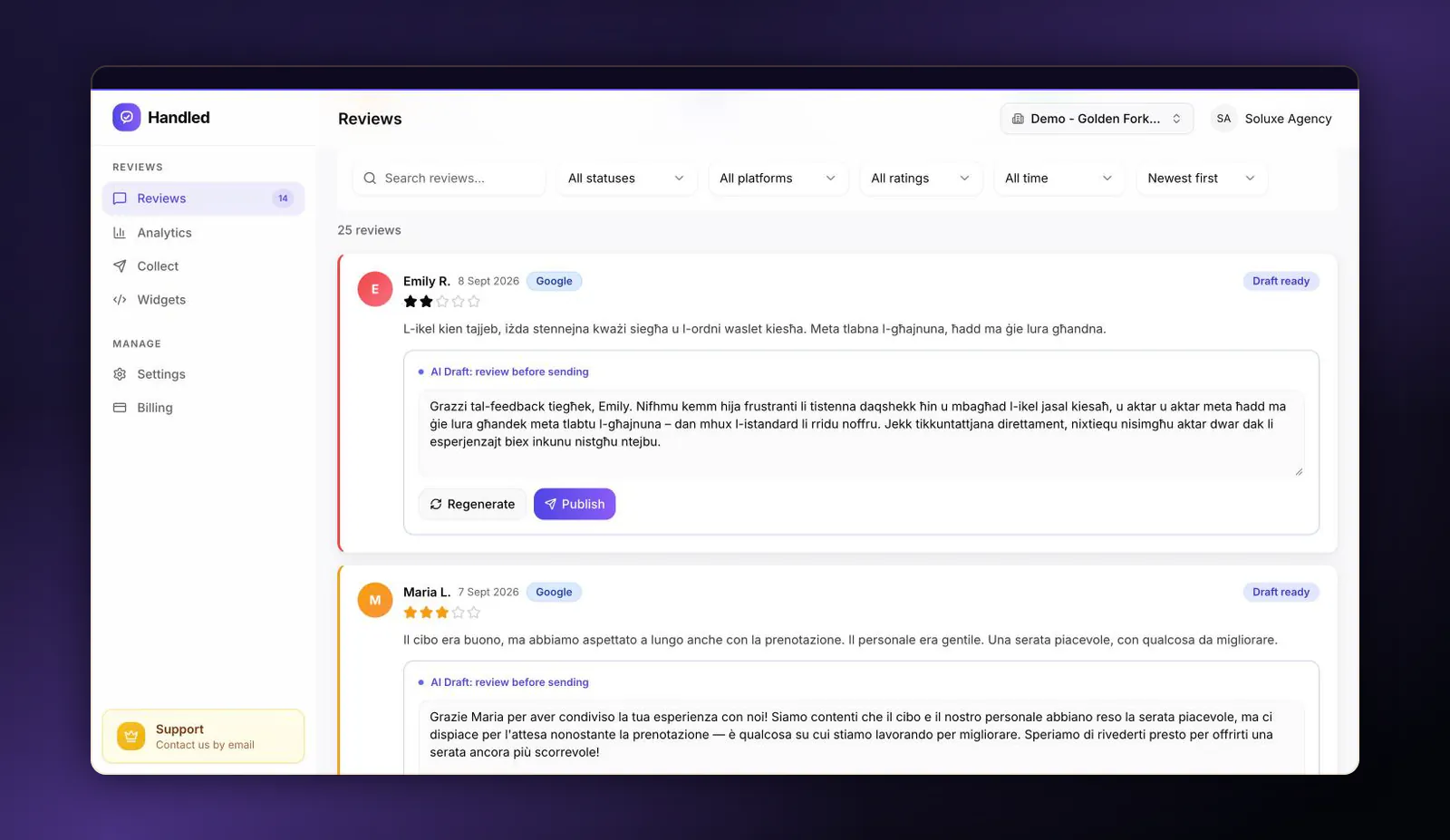
Each draft is built from the review and the voice the business has saved. The model works in the language of the review, and the interface labels every draft as one to review before sending.
That label matters as much as the model. Maltese drafts in particular need a human eye, and the product says so plainly instead of implying they are finished. Owners can edit, regenerate or leave a draft alone, and nothing happens until they approve it.
Why multilingual is more than translation
A reply that reads as translated feels cold, so the aim is a draft that reads as if it was written in that language. Tone is part of this. The warmth that works in an Italian thank you is not the same as in English, and Maltese has its own rhythm.
Voice matters as much as language. Each business saves its own voice, keeps its reviews separate and can list phrases it never wants to see. A family restaurant and a boutique hotel should not sound alike, even when the same system drafts for both.
What shipped
The product keeps reviews in one feed, drafts in three languages and tracks approval. It also has analytics on rating, volume and response rate, plus screens for review request links and website widgets. It runs today on a demo business with fictional reviews. Real Google publishing, review links and widgets are the next things to prove with real businesses.
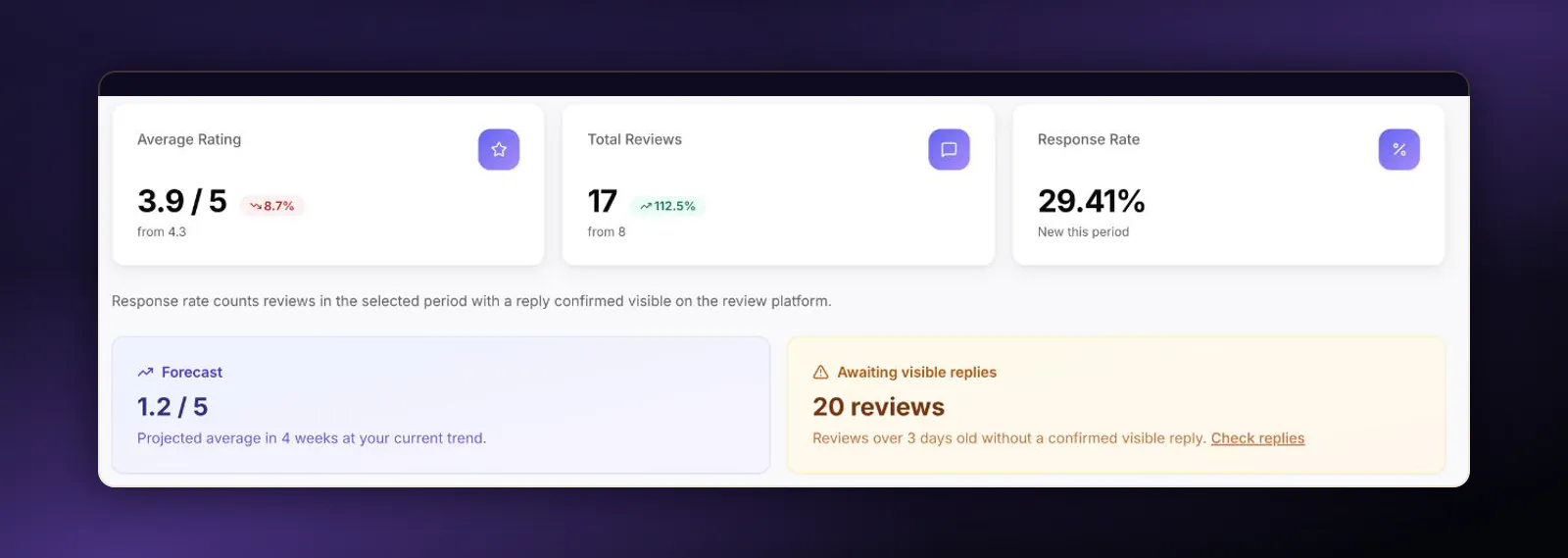
The interface stays quiet on purpose. Owners open it between jobs, so it uses one list, clear states such as Draft ready, and large controls. A tool that needs training will not get used by someone running a kitchen.
What we learned
A draft is not a reply. An audit before the September release showed our response figures were counting drafts. That flattered the numbers, so we changed the rule. Response rate now only counts a reply confirmed visible on the review platform. If a metric can be flattered by your own product, it will be.
Sent and visible are different states. Google can review a reply before it appears, so a product that says "published" the moment it sends is telling a small lie. We separated the two.
Imports must respect what is already there. The same audit found that a first import could lose an owner's existing replies. Nobody wants a tool to forget their history on day one, so we treated it as a release blocker.
Test the awkward paths. None of these problems showed up in normal use. They came from a deliberate audit of the paths people rarely take.
What is still to prove
We would rather be plain about this than let the screenshots imply otherwise. Handled has not yet published a reply to a real Google listing for a paying business, and no customer has used it. The demo business and its reviews are fictional. A pilot exists to prove the parts that a demo cannot: real reviews, real owners and the messy edges of a live account.
If you want something similar
Handled is one example of a pattern we use often: AI does the volume, a person keeps the decision, and the product is honest about which is which. If your team answers the same kind of message every day, in more than one language, that pattern fits.
The same approach works for support queues, enquiry replies and internal requests, built around your own data and tools. See the full Handled case study, read about our AI automation services, or see how we kept figures accurate on Malta Calculator.
Book a discovery call and tell us what your team repeats every week.