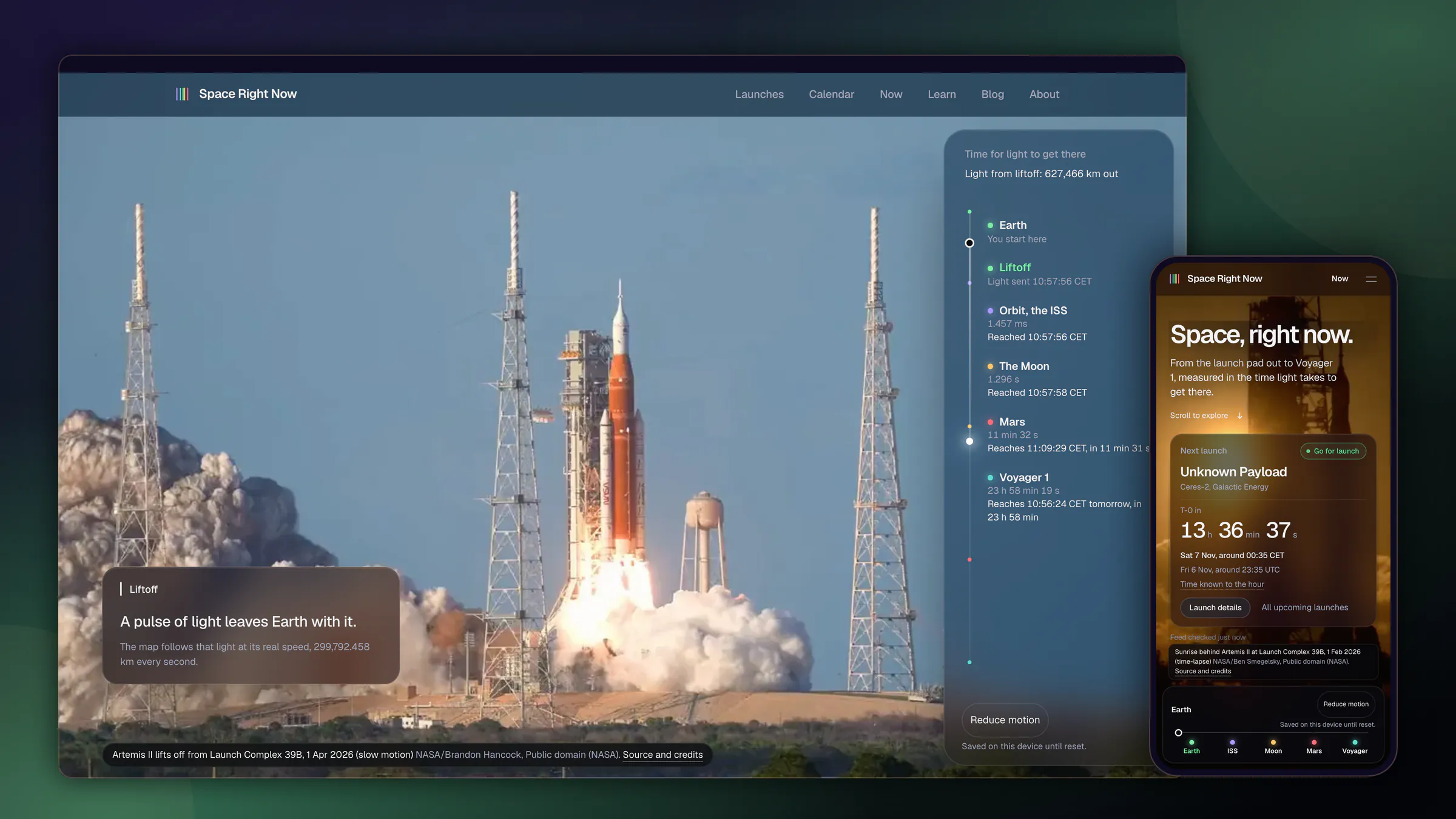
The liftoff chapter. Artemis II lifts off, 1 Apr 2026. NASA/Brandon Hancock, public domain.
A journey outward
On desktop, a 3D flight in six chapters from the launch pad to Voyager 1, with live figures in the panel beside it.
We use cookies to understand how visitors use the site, including analytics from Google Analytics, session analytics from Contentsquare and advertising measurement from Meta and OpenAI. Essential cookies are always on. You can accept these cookies or keep only the essential ones. Read our privacy policy.
Soluxe Venture
 Space Right Now
From the launch pad to Voyager 1, in light-travel time.
Space Right Now follows rocket launches, the International Space Station and Voyager 1 on one journey outward from Earth, and every launch time says how precisely it is known. It is a non-commercial project we built and run, with no ads, no accounts and nothing to buy.
A non-commercial project. Soft-launched in October 2026, with no promotion yet.
Launch times disagree between sites, and a published date can mean the minute, the month or a best guess. Most pages never say which, so people cannot tell how far to trust a time.
The liftoff chapter. Artemis II lifts off, 1 Apr 2026. NASA/Brandon Hancock, public domain.
On desktop, a 3D flight in six chapters from the launch pad to Voyager 1, with live figures in the panel beside it.
The launch schedule.
Every upcoming launch with provider, site, status and how far it has moved.
Each launch says how sure the date is.
Each launch says whether its time is known to the minute, hour, day or month, and keeps a record of date changes.
What changed in the last 24 hours.
A 24-hour briefing of status and schedule changes, built from stored records with observation times.
Voyager 1, captured on 6 November 2026.
A running countdown to the moment Voyager 1 is one light-day from Earth.
The Now page on a phone.
A 24-hour briefing of status and schedule changes, built from stored records with observation times.
We started from one frustration: launch times disagree. So every time on the site says how precise it is, and each launch keeps its own record of date changes.
Launch Library 2, CelesTrak and NASA/JPL data arrive on a schedule, and fixed rules decide what a time or a status means. AI does not decide launch times or statuses. Each source shows its last successful update, and the page says so when a feed goes stale.
The homepage is a six-chapter journey built in three.js, where every figure is computed or sourced. Phones and tablets get a film version, and a reduce motion control stays one click away.
AI agents wrote the code and the explanatory pages under our direction. Each of those pages says so and lists its sources, and the site uses no AI images or video.
Every film, texture and model is listed on a credits page with its licence and the edits we made.
Space Right Now shows how we turn messy, moving data into a product people can trust, at a scale of more than 1,000 pages, with a design that holds attention and search foundations underneath. If you have data that deserves a better home than a spreadsheet or a dated PDF, this is the shape of what we build.
Websites: Websites from EUR 7,000
This one is purely a passion project - I love space, and launch times never seem to agree from one site to the next, so we set out to build the clearest place we could to follow it all. There's nothing to sell here, it's just something I'm really glad exists.
Liam Colclough, founder
Next step
A 30-minute call with no deck and no pitch: an honest read on whether we can help and what the scope would look like.
We reply within one working day.
Trusted by teams at