
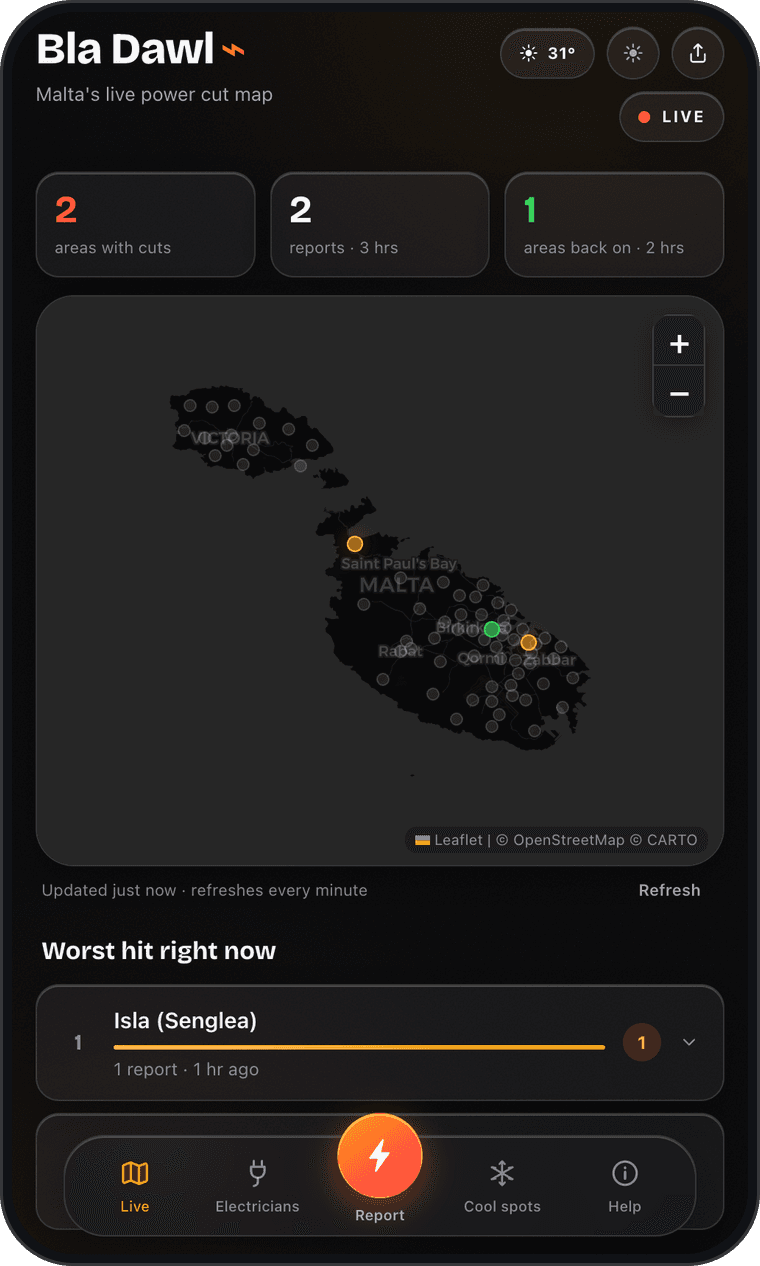
An AI development sprint compresses research, design, build, review and deployment into a timeframe most delivery teams would call impossible: days, sometimes a single working session. This case study shows what that looks like when it is real. On the evening of 23 July 2026, during Malta's heatwave power cuts, our team took a brief for a live public app from first sentence to production deployment before the night was out. Within 42 hours, 2,400 people were using it. Every number below is verified against analytics and the production database, caveats included.
The brief: Malta in the dark, in a heatwave
On 22 and 23 July 2026, repeated grid failures left Maltese towns without electricity in extreme heat. Community outage maps were going viral on social media. People urgently wanted to know three things: where the power was out, where they could go to cool down, and who could help if their own installation had tripped.
Nobody commissioned this. There was no client, no retainer and no invoice at the end. We watched the problem unfold, decided our delivery system was built for exactly this, and chose to ship something as a public-good project of our own.
The brief we set ourselves that evening: a free, mobile-first, live power-cut map and heat-relief app for Malta, at bladawl.com. 'Bla dawl' is Maltese for 'without power'. The app is not affiliated with Enemalta, the grid operator, and says so prominently.
What shipped on night one
Research, design, build, review and deploy all happened in a single evening session on 23 July. This is what the public got in version one:
- A live outage map covering all 68 Maltese localities, where reporting an outage takes two taps
- Restoration reporting, so anyone can mark 'power is back' and the map clears itself as the grid recovers
- A directory of 40 verified electricians, 23 of them advertising 24/7 service, each traced to a published source before inclusion
- 31 verified cool spots, from air-conditioned malls and libraries to pools and beaches, with opening hours
- Verified help content: emergency numbers, heat-health, food-safety and blackout guidance, with every number checked against primary sources before launch
- A privacy-first build: no accounts, no personal data, locality-level reporting and cookieless analytics, so no cookie banner is needed. It installs as a PWA and ships with light and dark themes
Malta did not wait to be told about it. The first public outage report arrived about 10 minutes after go-live. At the launch night peak, the map took 141 reports in a single hour at 21:00 local time. By the end of launch night the production database held 479 reports from 429 unique devices.
What happened when Malta found it
The first 42 hours, straight from analytics:
- 2,400 users, all new, across 2,700 sessions and 12,000 page views
- 399 outage reports tracked as analytics events
- Roughly 2,000 sessions from organic social, almost entirely Facebook shares, plus 557 direct and 189 from organic search
- 2,300 of the users were in Malta, with a small tail from the UK, Italy and the US
- Most-viewed screens: the home map at 6,300 views, the report flow at 2,800, cool spots at 1,700 and the electricians directory at 1,300
The crowd dataset in the production database tells the same story from the other side. 661 reports arrived within the first 30 hours. The full crisis dataset reached 708 reports from 602 unique devices across 55 of Malta's 68 localities, including 165 'power is back' reports and 169 distinct streets named. The app is still live and still collecting: 729 reports as of 28 July.
Two honesty caveats. Analytics went live roughly four hours after launch, so early traffic is undercounted. And reports are counted per device rather than per household, so the true outage footprint is larger than any figure here. Treat these numbers as floors, not a census.
How an AI development sprint ships this in an evening
The answer is a delivery system. Soluxe runs an AI-native delivery system: fleets of AI agents researching, building and reviewing in parallel, with senior human direction and taste making the calls. We keep the internals to ourselves, but the pattern is why the timeline above is real. We have written a full guide to AI development sprints, and our AI and automation deep-dive covers where this model fits in a wider operation. Four things made the difference on this build.
Research ran in parallel. While the product was being designed, parallel AI research agents compiled the datasets: the electricians, the cool spots, the emergency information. Every fact was traced to a published source before it shipped, and that verification caught a wrong emergency number before launch. In a crisis app, checking matters more than speed.
Review was adversarial. Before go-live, adversarial AI review agents attacked the build and surfaced 20 real issues, spanning accessibility, map gestures and edge cases. All of them were fixed the same evening. That gate is what let us ship fast and still ship clean.
The stack was deliberately boring. A modern web stack built on Next.js, globally deployed, and designed to stay useful year-round: the app reactivates automatically when the next outage hits. It is the same engineering discipline we bring to client website builds.
Iteration carried on while traffic was live. The next morning, 24 July, a street-level map upgrade shipped: reported streets now draw as coloured lines on the map, powered by 16,772 street geometries from OpenStreetMap. Matching is deliberately conservative, measured at roughly 73 per cent recall with zero wrong-street matches, because a wrong red line would misinform, and ambiguity means no line. On 27 July the SEO layer, safety guides and a public data blog shipped. On 28 July, a free embeddable live-status widget for newsrooms.
What survived contact with 2,400 users
Plans meet reality at go-live, and a few decisions earned their keep once real users arrived under real stress.
Two-tap reporting worked. The report flow was the second most-viewed screen in the app, and hundreds of people who had never seen it before filed usable reports in the dark, on their phones, without instructions.
Zero wrong-street matches proved the conservative matching right: the map never told anyone their street was out when it was not. A crisis tool that cries wolf once loses the trust that makes it useful.
Restoration reporting kept the map honest, and the privacy-first build kept it frictionless. With 165 'power is back' reports, the map cleared itself as the grid recovered rather than freezing at the worst moment and slowly becoming fiction. Meanwhile no accounts, no personal data and no cookie banner meant nothing stood between a person in a blackout and the map, and nothing for us to maintain or breach.
Since launch week the app has grown a longer-term layer: indexable safety guides, structured data, llms.txt, Google Search Console verification across 12 pages, the public data blog and the newsroom widget. Built in an evening, and built to last anyway.
What an AI development sprint could do for your business
Bla Dawl was built to help people through a crisis, and that remains the point of it. The business lesson comes second, but it is hard to ignore: a production-quality product went from brief to the public's hands in one evening, then improved daily while thousands of people used it.
Translate that to commercial work. The same system that shipped Bla Dawl delivers client products through our AI and automation service: marketing sites, internal tools, MVPs, data products and workflow automations. If your roadmap has an idea stuck at 'we should build that', the bottleneck is usually delivery capacity rather than the idea itself. A sprint removes that bottleneck, and you find out in days, with real users, whether the idea deserves further investment. You can see more of our delivery work on our work page.
Frequently Asked Questions
What is an AI development sprint?
An AI development sprint is a compressed delivery model in which fleets of AI agents handle research, code and review in parallel, while senior humans set direction and make the judgement calls. Because the phases overlap instead of queueing, a brief can reach production in days, sometimes the same evening. The human layer is not optional: it owns taste, quality and the decisions that matter.
Was Bla Dawl really built in one evening?
Yes. Version one, with the live outage map, the electrician directory, the cool spots and the verified help content, went from brief to production deployment in a single evening session on 23 July 2026. The first public outage report arrived about 10 minutes after go-live. Improvements then shipped daily: street-level mapping the next morning, an SEO layer on 27 July and a newsroom widget on 28 July.
Does shipping that fast compromise quality?
Not when the sprint includes a real quality gate. Before Bla Dawl went live, adversarial AI review agents attacked the build and surfaced 20 real issues covering accessibility, map gestures and edge cases, and all of them were fixed the same evening. Fact verification also caught a wrong emergency number before launch. The speed comes from running every phase in parallel, with the checks still in place.
What kinds of projects suit an AI development sprint?
Anything with a clear outcome and a reason to move quickly: marketing sites, landing pages, internal tools, MVPs, data products and automations. Sprints are especially strong for validation, because you learn from real users in days rather than debating a specification for months. Larger platforms benefit too, delivered as a sequence of sprints with working software at every step.
Ship something real this week
If a product, tool or site on your roadmap has been waiting months for a build slot, the fix is a different delivery model. Tell us what you want shipped, even the idea you had written off as too slow to build, and we will tell you what a sprint can do with it, and how fast. Bring us the brief on a discovery call.