Anyone trying to work out the Malta cost of living has the same problem: the figures are spread across official sites, PDFs and retailer pages, and they change. A bus fare, a water tariff or a tax band can move without much notice, and a calculator is only as good as its last check. We built Malta Calculator to solve that second problem as much as the first. It is a free set of tools for everyday costs in Malta and Gozo, and it shows in public when each source last matched. This post explains how it works, including the morning a wrong fare went live.
Why Malta cost of living figures are hard to keep right
Building a calculator is the easy part. Keeping it right is the work.
Most tools carry a year in their title and little else. A reader cannot tell where a figure came from or when anyone last looked. That matters when someone is budgeting a move or checking their take-home pay.
The Malta cost of living also has local detail that generic tools miss: bus tickets that vary by season and time of day, water bands that depend on household size, ferry fares, and bottle deposits. Each one needs a real source.
Add the rest of a household budget and the list grows quickly: electricity, fuel and parking, groceries, rent and moving costs, appliances, eating out, mobile and broadband, and a net salary to set it all against. Those figures sit with different bodies, in different formats, and they change on different schedules. No single page brings them together, and that gap is why we built one.
The decision to build
We wanted a showcase of how careful content, design and automation work together, and Malta gave us a real need. The goals were plain: be useful, be findable, and be right. The third goal shaped everything else.
So we designed the check first and treated accuracy as a product feature, not a promise in the footer.
Architecture and stack
The site runs on Next.js and Vercel. Fares and tariffs live in one checked file. The calculators, the direct answers on each page and the guide tests all read from it, so a figure is changed in one place, not several.
A check is scheduled for every Monday at 10:00 Malta time. It reads the official pages it can reach, finds each value beside its own label and compares it with what is published. There are three outcomes. If the values match, the date moves. If a page has changed layout or refused the request, it shows as could not verify, and the old date stays. If a value has changed, nothing updates: a pull request and an alert go to a person.
Income tax and social security tables are rechecked by hand, because those sites refuse automated reads. We say so on the site rather than implying otherwise.
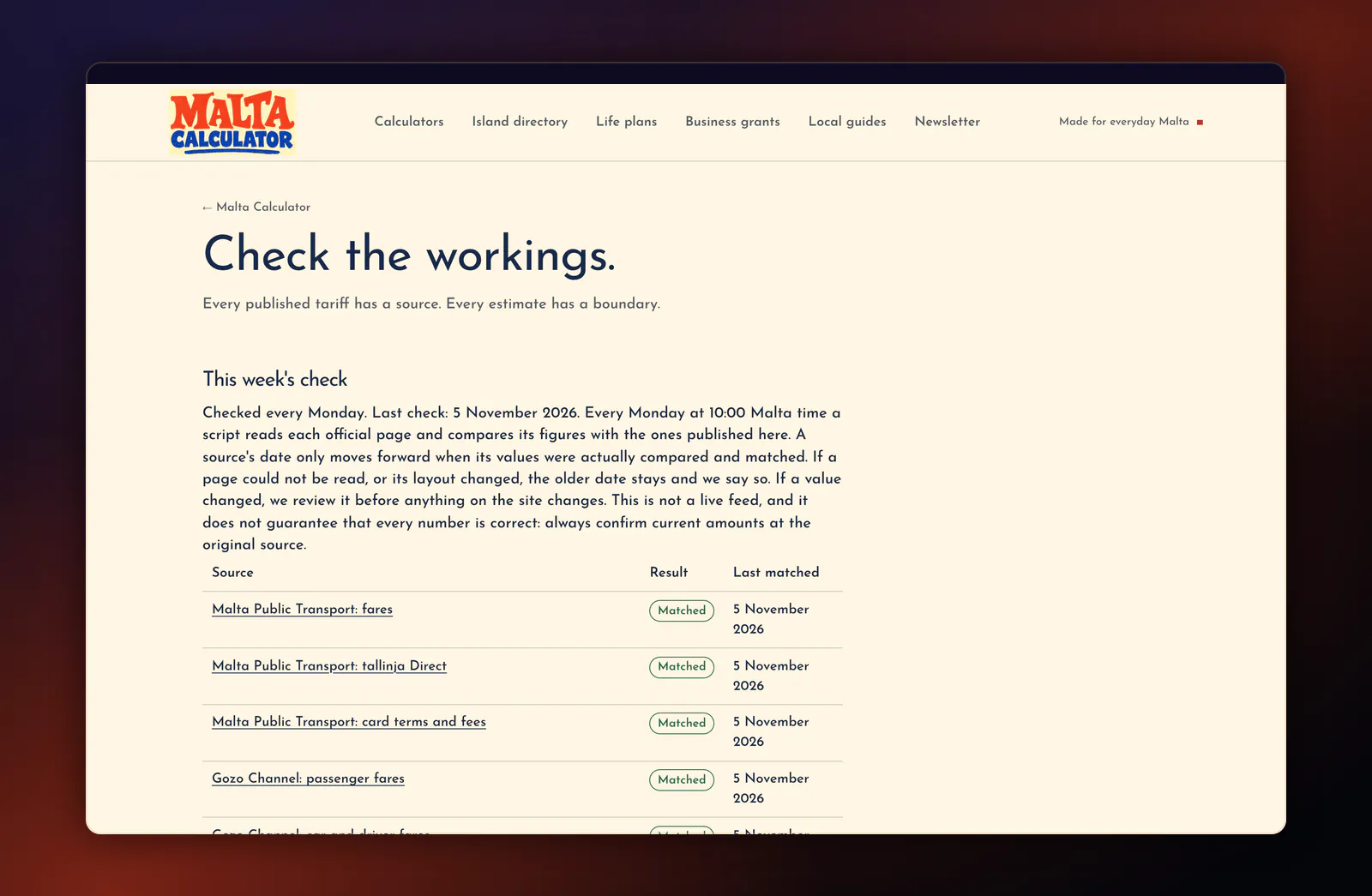
Three dates, three meanings
The word "updated" hides a lot, so the site separates three things. A source check date says when our check last compared a figure with its source. A price observed date says when a retailer's price was recorded. A report date says when we prepared a piece of content. Each is true, and they are rarely the same day. Spelling that out on the site takes a few lines of copy and removes a whole class of misunderstanding.
The AI layer and its guardrails
AI helped us build this far faster than we could have otherwise, but it does not decide what a figure is. Official figures never change without a person. Weekly retailer offers arrive as a pull request, and an AI agent checks them against the retailer's own page before merging, under set limits.
Each tool also opens with the current figure in plain words, read from the same checked data as the calculator. That helps a person in a hurry, and it gives search engines and AI answers a clear, sourced statement to work with. Structured data and an llms.txt file support the same goal.
Built to be found
A free tool only helps if people find it, so search shaped the build rather than following it. Each tool answers one real question, and the answer sits at the top of the page. Guides cite their sources and link to the matching tool. New pages notify search engines after each deploy, and guides go out on a schedule rather than in one burst.
Search research also set priorities. Net salary was the largest gap, with far more search demand than most of the other tools, so we built that calculator next. It went live on 5 November 2026, and its tables are due a recheck in January 2027 when the new year's rates apply.
What shipped
Malta Calculator launched in November 2026 with 15 free tools: 14 cost calculators and a business grants checker. There are also 10 sourced guides, three connected plans for moving in, a short holiday and a commute, and an island directory for getting around.
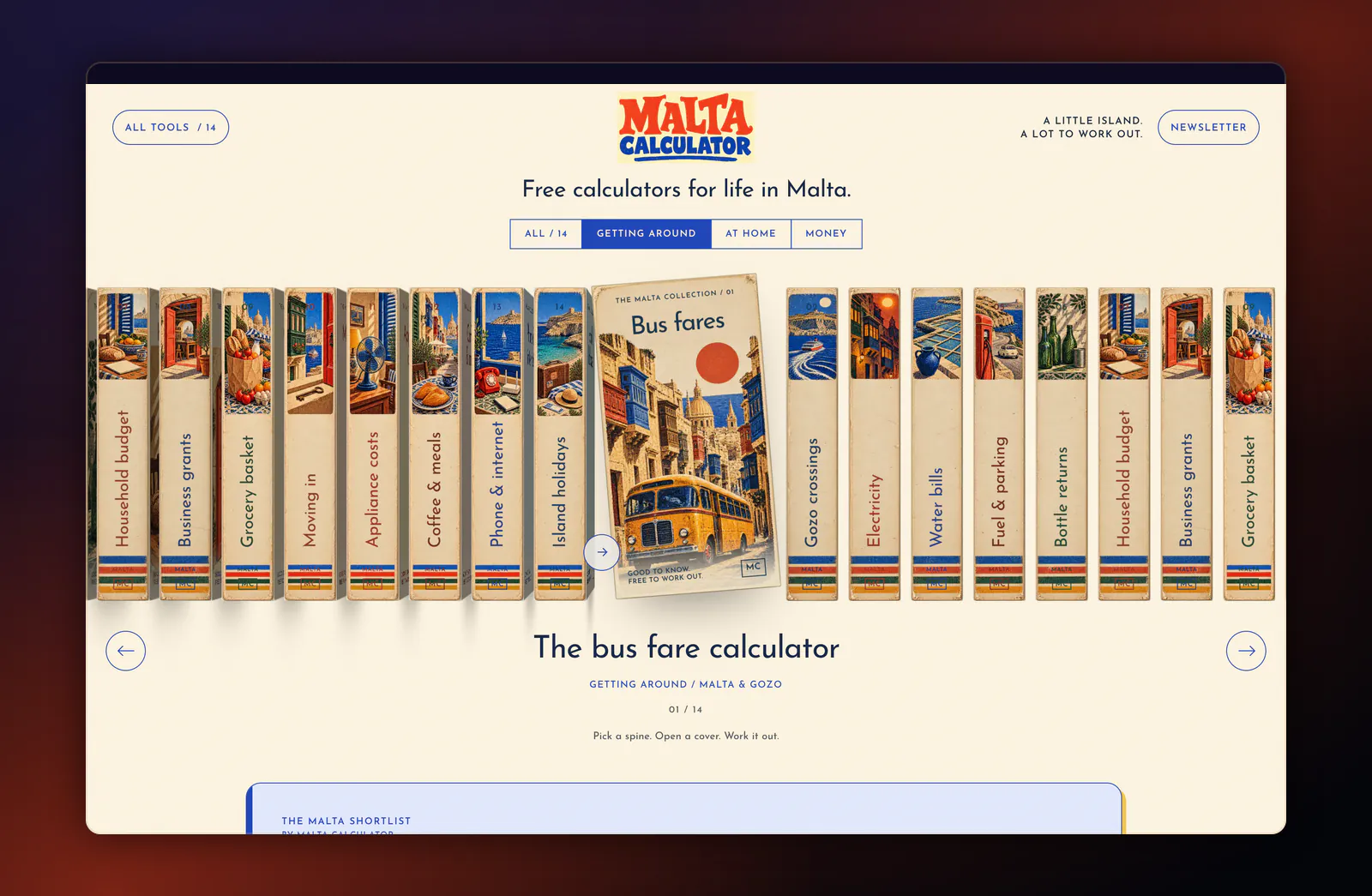
The homepage is an illustrated shelf of books. Pick a spine, open a cover. It gives a utility site some character, and the Malta artwork does what a generic template could not.
The tools are designed around trust as much as sums. Each one sets "Your numbers" beside "The estimate", starts from an example labelled as an example rather than an average, and keeps a clear note on every page that these are estimates. A person budgeting a move needs to know what a figure is, and what it is not.
It is private by design. Figures typed into a calculator stay in the browser, and analytics only run after a visitor accepts them. The site is new, so we are not claiming traffic or ranking results here. We will share them once they are real.
What we learned
Test the failure path, then test the test. During the first forced test of our alert system, a proposal reached the main branch and a wrong winter bus fare went live for about a minute: EUR 2.50 instead of EUR 2.00. We reverted it with a normal commit and confirmed the live page. Then we fixed the cause. Proposals now use a separate copy of the code, a forced test carries no value, and tests pin all three rules. Our own safety net caused the error, and that is the lesson.
Could not verify is an honest answer. Sites change layout and block automated reads. A check that says matched when it could not read the page is worse than no check. Showing the gap builds more trust than hiding it.
Not everything can be automated. Two of the most important tables need a person. Planning for that from the start beat pretending otherwise.
If you want something similar
If your site carries prices, rates or rules that go out of date, the same approach applies: one source of truth, pages built to be found, and a process that keeps working after launch.
See the full Malta Calculator case study, read about our SEO and content services, or see how we handled live data at a larger scale on Space Right Now.
Book a discovery call and tell us which numbers on your site worry you most.